
Every AI Answer Passes Through Three Sequential Gates
When someone asks ChatGPT a question about your industry, a lot happens before the answer appears. Most of it is invisible to both the person asking and the company being discussed. Understanding that invisible process is the difference between knowing why AI includes you and guessing about it.
AI systems do not just fetch a webpage and repeat what it says. They run every piece of available data through a three-gate process before deciding what to include in an answer. We call this Answer Architecture, and understanding it turns a mysterious black box into a diagnostic tool.
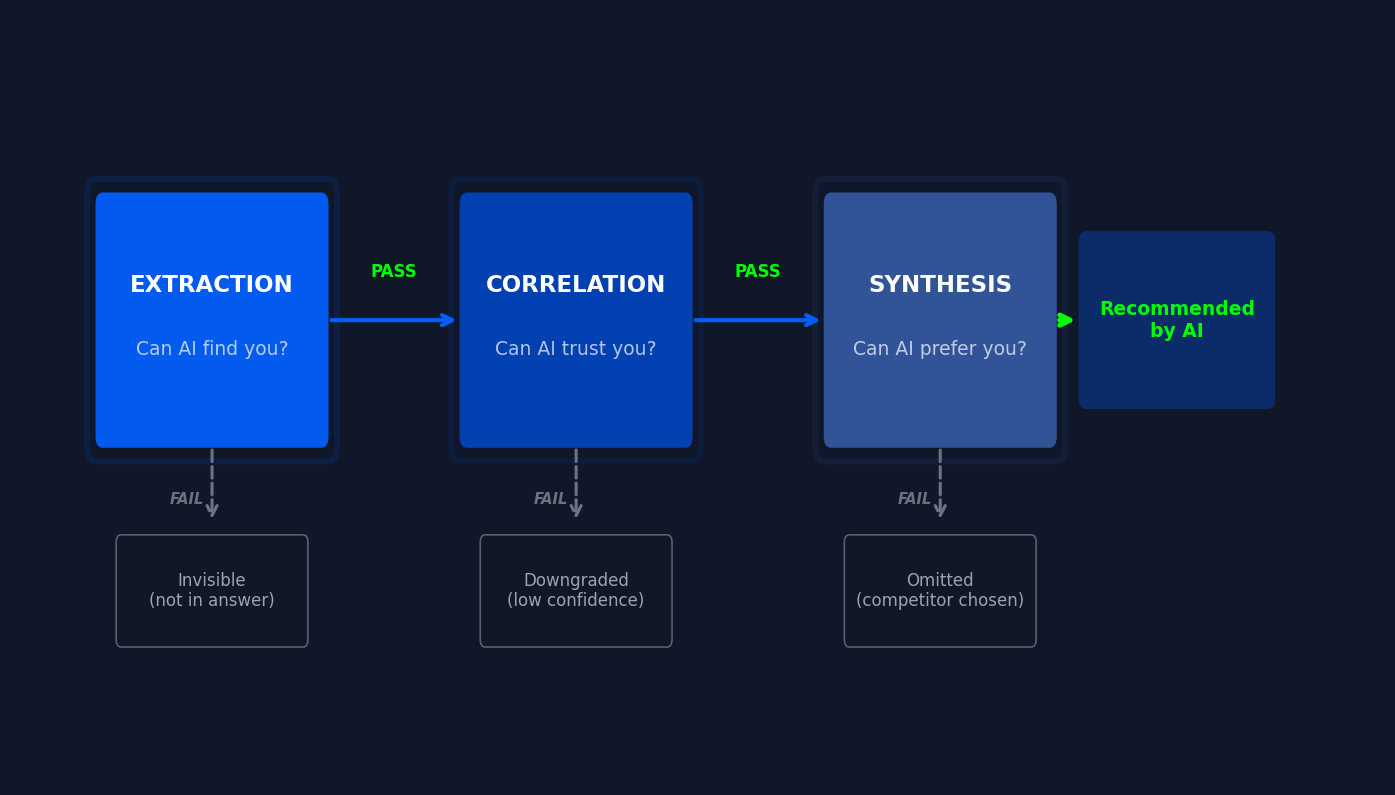
The three gates, always in this order: Extraction, Correlation, and Synthesis.
Gate One: Extraction Determines Whether AI Can Find You
Extraction is the gate of findability. When a query arrives, the AI system needs to identify which information in its knowledge base is relevant. This is not a keyword match. It is an entity and context recognition process.
The system identifies the key entities in the query (a product category, a use case, an industry) and retrieves information tagged as relevant. If your data is well-structured with clear schema markup, proper semantic tagging, and strong knowledge graph connections, the system extracts it early and accurately. If your data is buried in unstructured prose, uses inconsistent terminology, or lacks the structured signals that help machines categorize it, extraction fails. Your information exists, but the system cannot find it cleanly.
Think of extraction like a filing system. A well-organized cabinet lets a clerk find the right file in seconds. A pile of unlabeled documents means the clerk finds it eventually or grabs the wrong file or gives up. AI systems are the clerk. Your data structure is the filing system.
Extraction problems typically point to two things: missing or broken schema markup, and weak knowledge graph connectivity. If AI cannot find you through the paths it traverses, your data effectively does not exist for that query.
Gate Two: Correlation Determines Whether AI Trusts You
Correlation is the gate of trust. Once the system has extracted candidate information, it cross-references it against other sources to determine confidence.
This is where your Clarity is actually calculated, even though no single AI system will show you the score. The system checks whether your claims align with what other sources say. If your website says your product starts at $199, your Google Business Profile says “contact for pricing,” and a directory listing says “plans from $149,” the correlation engine detects a conflict. When sources disagree, the system either downgrades confidence in your data or omits it entirely rather than cite something uncertain.
This is also where third-party proof enters the picture. If a Forrester report mentions your company favorably, that is an independent source that agrees with your own claims. The system correlates the two and confidence rises. If the only source mentioning your capabilities is your own website, confidence stays low regardless of how impressive the claims are.
Correlation problems typically point to inconsistency across platforms or claims that contradict external sources. The fix is straightforward but tedious: audit your data everywhere it appears and make it agree with itself.
Gate Three: Synthesis Determines Whether AI Prefers You
Synthesis is the gate of relevance. After extracting and correlating, the system compresses everything into a natural-language answer. This is where the actual response gets built, and it is where recency often decides the winner.
When multiple sources pass extraction and correlation, synthesis picks which ones to include in the final answer. The system compresses information into a concise response, and compression favors clarity and freshness. Between two equally accurate and well-correlated companies, the one with the more recent case study, the more current data, and the fresher content wins the synthesis gate.
Synthesis problems look like this: you know your information is accurate and consistent, AI systems can find it, but you still do not get mentioned in answers. The diagnosis usually points to stale content. Your competitor published a new case study last month. Yours is from two years ago. The synthesis engine favors the fresher source.
Each Gate Maps to Specific, Actionable Fixes
The practical value of understanding Answer Architecture is diagnostic. When your company is not showing up in AI answers, the three gates tell you where to look.
If AI never mentions you at all, even for queries where you clearly qualify, you likely have an extraction problem. Your data exists but machines cannot find it. Check your schema markup, knowledge graph connections, and structured data quality.
If [AI mentions] you sometimes but gets key facts wrong, you have a correlation problem. Your data is findable but the system does not trust it fully because of inconsistencies. Audit your data across platforms and fix the contradictions.
If AI knows who you are and gets the facts right but consistently recommends competitors over you, you have a synthesis problem. You are trusted but not preferred. Look at recency (is your content fresher than competitors’?) and evidence strength (do you have the third-party proof that tips the scale?).
Each gate maps to specific, actionable fixes. You do not have to guess. The three gates give you a diagnostic framework for understanding exactly where your information infrastructure is failing and what to fix first.
The Three Gates Are an Information Quality Problem, Not Just an AI Problem
The three gates are not just an AI problem. They are an information quality problem that happens to matter a lot for AI. The same inconsistencies that confuse AI systems also confuse buyers, sales teams, and partners. When your pricing says one thing on the website and another in a proposal, that is a correlation problem whether the observer is a machine or a human.
Fixing the three gates means building information infrastructure that works for both. Accurate, consistent, specific, current, and connected data serves machines and humans equally well. The diagnostic framework just makes the priorities visible.
For a full readiness assessment across all three layers, see our AI readiness framework. The question is not whether your information has problems. Every company’s does. The question is which gate is failing first, and how much pipeline you are losing because of it.




Find Out What AI Tells Buyers About You
An AI visits your site and reports everything it found. Scored across six categories with machine-verifiable findings. No cost, no pitch.
Get Your Free Snapshot