New data from B2The7 reveals something every marketing leader should internalize: the correlation between traditional search rankings and AI citations has collapsed.
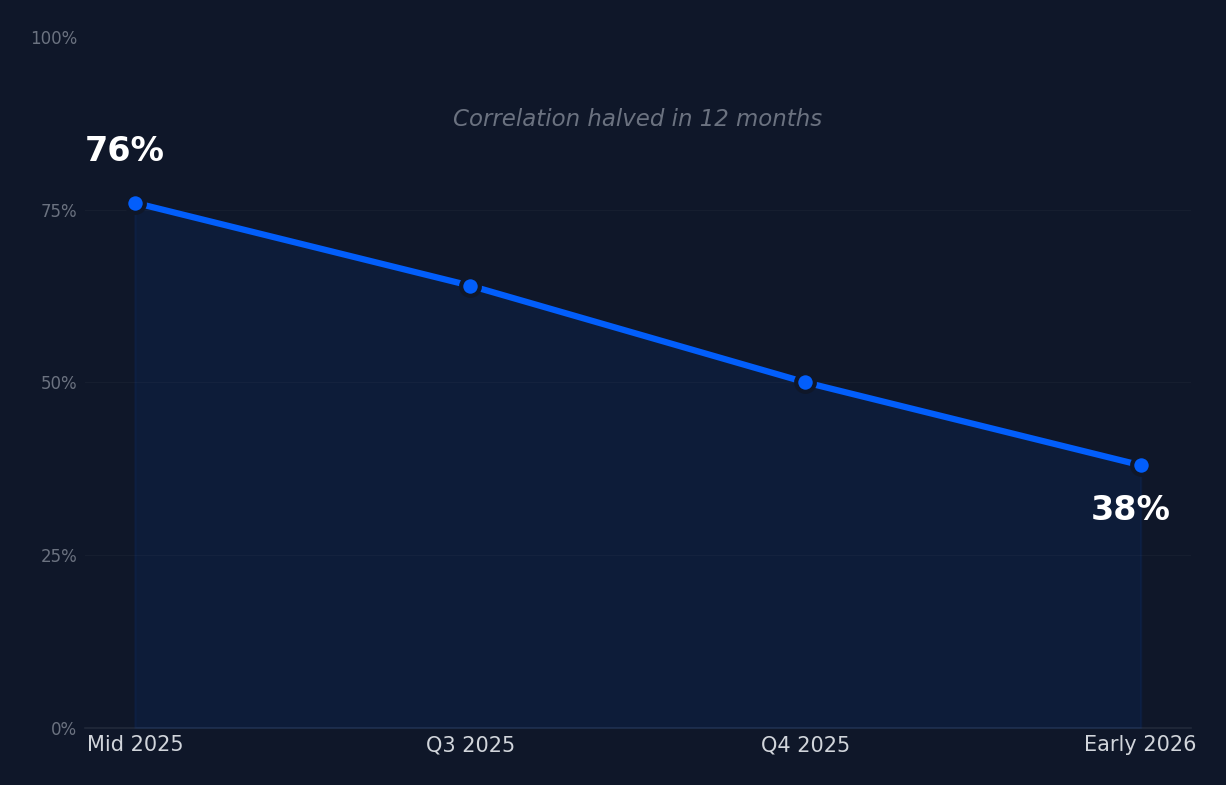
In mid-2025, ranking in the top 10 organic results predicted 76% of AI citations across major answer engines. By early 2026, that number dropped to 38%.
That is not a gradual decline. It is a structural break. And it is still trending down.
What the Data Shows
B2The7 analyzed citation patterns across ChatGPT, Perplexity, Google AI Overviews, and other major AI answer engines. The findings track how often a brand or source gets cited in an AI-generated answer.
The key finding: traditional SEO performance has become a weak predictor of AI visibility. A site ranking first for a query has only a marginally better chance of being cited by an AI engine than a site ranking fifteenth. The gap that mattered so much in traditional search, the gap between page one and page two, barely exists in AI citation patterns.
Meanwhile, Google’s AI Mode recently crossed 1 billion monthly users. That is a billion interactions per month where the answer engine synthesizes a response instead of sending users to ten blue links. The traffic you are optimizing for is flowing through a different channel now.
Why Rankings Stopped Predicting Citations
AI answer engines do not select sources the way traditional search ranks them. Traditional search rewards authority signals, backlink profiles, and on-page optimization refined over years of algorithm updates.
AI engines weigh those factors, but they also prioritize narrative coherence, entity relationships, and source diversity within a synthesized answer. An LLM composing a response pulls from the sources that best help it construct a useful answer, not necessarily the sources that rank highest for the query.
This means the work that got you to page one does not translate directly into citation frequency. The three gates every AI system runs your data through (extraction, correlation, synthesis) evaluate your content on completely different signals than a ranking algorithm.
This means the work that got you to page one does not translate directly into citation frequency. Technical SEO, link building, and content production for keyword targets remain valuable for traditional search. But they are no longer sufficient for AI visibility. The rules of inclusion are different. The signals that matter to an LLM composing an answer are not the same signals that matter to a ranking algorithm sorting results.
This is what we call the Coverage Strength gap at CKI Labs. A brand can have strong traditional search performance and weak AI citation presence at the same time. The data from B2The7 confirms this is now the norm, not the exception.
The Real Cost
Most marketing budgets are still built around traditional SEO. Six-figure retainers for ranking improvements. Content production aimed at keyword targets. Technical audits focused on crawlability and indexation.
These investments still produce value for traditional search traffic. But the assumption that strong rankings translate into strong AI visibility is now demonstrably false. Companies spending heavily on traditional SEO are paying for diminishing returns in the channel that is actually growing.
AI answer engines are where buyers are forming opinions, narrowing consideration sets, and getting recommendations. Google AI Mode alone is a billion interactions per month. Add ChatGPT, Perplexity, and Gemini, and the total audience being shaped by AI answers is already comparable to traditional search.
If your brand is absent from those answers, the pipeline impact is real. Not theoretical. You are losing consideration before buyers ever reach your website. This is what Conversion Collapse looks like from the demand side.
The Reframe
The question is not how to rank higher. The question is how to get included in AI answers.
These are different problems with different solutions. Ranking higher is an SEO problem. Getting included in AI answers is a visibility problem with its own dynamics, its own signals, and its own remediation path.
At CKI Labs, we focus on AI visibility, not search rankings. Our C3 Diagnostic measures whether your brand shows up when buyers ask AI engines about your category, identifies the specific reasons it does not, and maps those reasons to fixes.
We do not try to improve your rankings. We diagnose why AI engines exclude you and fix the structural issues that keep you out of the conversation.
The shift from SEO-first thinking to AI visibility is not about adding another channel. It is about recognizing that the channel where buyers make decisions has changed, and adapting your strategy to match.
What to Do Now
If you are a marketing leader, the 38% figure is your reason to reallocate. Traditional SEO budgets are built on the assumption that rankings drive visibility. That assumption is now broken. The correlation has halved in under a year, and the trend line points further down.
Start by measuring your actual AI visibility. Not your rankings. Not your traffic. Whether your brand appears in AI-generated answers when buyers ask about your category. That baseline tells you where you actually stand.
Then diagnose the gap. Find out why you are absent and what is driving competitors’ inclusion. The reasons are specific and fixable, but only if you look. Start with your Clarity Index to see what AI actually understands about your business.
The brands that adapt to this shift early will capture attention in the channel where buying decisions are increasingly made. The ones that wait will watch their traditional rankings climb while their pipeline shrinks.

Find Out What AI Tells Buyers About You
An AI visits your site and reports everything it found. Scored across six categories with machine-verifiable findings. No cost, no pitch.
Get Your Free Snapshot